


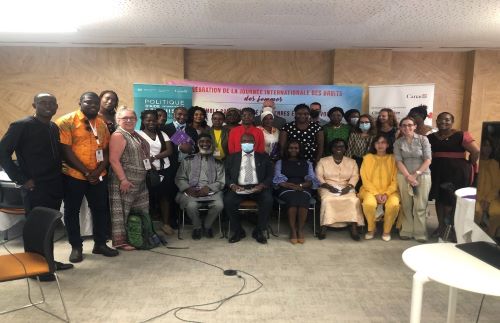
At the invitation of the Canadian Embassy in Cote d'Ivoire, the African Development Bank, Africa Climate Change Fund (ACCF), and some 100 participants met on 7 March 2022 in Abidjan to kick off the 45th International Women's Day celebration.
The theme for this year's celebration was "Equality today for a future sustainability," reflecting women and girls' contribution to climate change.
In his opening remarks, the Canadian Ambassador to Cote d'Ivoire, Claude Demers, acknowledged women's inestimable leadership role in their communities and thanked those who led tireless efforts to improve women's living conditions.
Ambassador Demers added: "Giving women and girls equal opportunities to succeed, through increased participation in decision-making and more equitable access to resources is the most effective way to achieve the Sustainable Development Goals."
Speaking on feminine inspiration, women, and climate change, Africa Climate Change Fund's Coordinator, Rita Effah, underscored ACCF's drive to support African countries to access climate finance and implement small-scale adaptation projects to build the resilience of vulnerable communities, especially women and girls. She presented the ACCF, its focus, operational modalities, and how eligible institutions could access funding from the Fund as well as highlighted some of the results of the Cote d’Ivoire project.
Effah said, "The ACCF plans to shift its portfolio to mainstream gender equality into the climate adaptation projects it finances by adopting a Gender Transformative Climate Adaptation Approach."
Since 2021 the ACCF has shifted toward supporting Gender Equality and Climate Resilience (GECR). To implement the GECR, the ACCF has adopted the universal Gender Transformative Approach to engage men and women as agents of change, from the household scale to the community and beyond, to shift constrictive gender norms and other structural barriers to strengthen the persistence of gender inequality and unequal power balance. The approach is critical to helping the ACCF tackle the root causes of gender inequalities, unequal power balance, and vulnerability and contribute to a more inclusive, equitable, sustainable, and sustainable climate-resilient development transition.
With support from its donors, including Global Affairs Canada, the Government of Quebec, and others the ACCF's Third Call for Proposals on Gender Equality & Climate Resilience will select and implement about ten projects that will seek to address the root causes of gender inequality such as power imbalances, unequal access to resources that impacts both women, girls, and youth to adapt to their climate resilience to climate change impacts.