


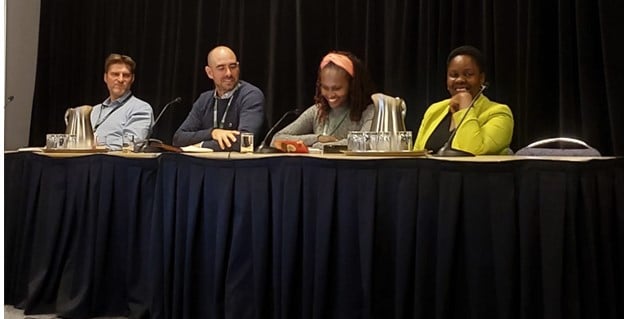
Caption: L-R - Andy Kerr, Climate-KIC; Biron Nicolas, Desjardins International Development (DID); Rita Effah, AfDB, Africa Climate Change Fund; Edith Ofwona Adera, AfDB, Africa adaptation acceleration program (AAAP) during an Adaptation Fund Innovation Days session at the Adaptation Futures 2023.
The African Development Bank set out ways to support Africa’s youth-led small enterprises to grow sustainably and build climate resilience through innovative financing mechanisms at the Adaptation Futures 2023 conference in Canada.
Representatives from the African Development Bank's, Africa Adaptation Acceleration Programme (AAAP) and the Africa Climate Change Fund (ACCF) attended the Montreal conference to highlight some of the lessons learned in scaling adaptation solutions throughout the African continent.
The AAAP coordinator, Ms Edith Ofwona Adera, emphasized that in order to support the sustainability and growth of youth-led enterprises, financing must transition from grant-based to highly concessional funding coupled with technical assistance. "A proposed $500 million SME green financing facility will provide concessional funding in the form of debt , guarantees, and equity alongside TA (technical assistance) grants that strengthen the capacity of financial institutions to unlock financing for young entrepreneurs," she explained at the conference's Adaptation Fund Innovation Days session.
"Ten percent of the resource allocation of the Facility will be channeled to technical assistance to build capacities of financial intermediaries and enterprises in climate finance structuring, enterprise development and performance monitoring," she said.
Through the AAAP's YouthADAPT programme, the African Development Bank is already providing $4 million to 33 young entrepreneurs in 19 African nations to help them scale their businesses and deepen their impact. The programme’s beneficiaries have demonstrated excellent early results, including a 123% increase in average revenue, the creation of nearly 8,500 direct and indirect jobs, the securing of $316,874 from other sources, while 20% of the enterprises have ventured into new markets.
Rita Effah, Coordinator of the ACCF, said the Fund had played a critical role in supporting youth-led climate initiatives. "The ACCF is a catalytic fund that provides funds directly to communities, including young entrepreneurs...We have supported 28 projects in 26 countries that are helping communities to address the immediate impacts of climate change and to build resilience," Rita explained.
Last year, the ACCF approved grant financing of $1 million to the AAAP’s YouthADAPT to support women-led enterprises deploying frontier technologies for climate adaptation in Africa. The technical assistance will create innovative, transformative climate-resilient bankable projects that are compatible with African countries' Nationally Determined Contributions (NDCs) to reduce climate emissions and address the impacts of climate change. Eight of the winning women-led businesses will be unveiled in December 2023 during the COP28 UN climate conference in Dubai.
Dr. Olufunso Somorin, Regional Principal Officer at the African Development Bank, stressed the need to address the disparities between demand and supply sides of climate finance capital. It is important to establish more facilitative mechanisms that can bridge the gap by aligning the financial terminology used, he said.
More than 95% of climate adaptation finance flows into Africa are largely through two financial instruments: concessional loans and grants. Yet, other instruments such as equities, bonds, swaps, guarantees, and other risk sharing instruments have not been fully explored for climate adaptation as compared to mitigation. “I strongly believe that youth-led adaptation programs can be a good testing point for all of these instruments as we seek to make more business cases for adaptation solutions,” Somorin added.
The Bank delegation also attended a session on "Catalysing Food Systems Transformation," which was co-hosted by Columbia University, Clim-Eat, International Development Research Centre, and Tetra Tech. This session highlighted lessons learned in the Bank’s support to boost Ethiopia's wheat production. Four years ago, through the Technologies for African Agricultural Transformation (TAAT), the African Development Bank began to support Ethiopia to cultivate heat tolerant wheat varieties. This underpinned rapid growth in wheat cultivated areas to 800,000 hectares in just four years. Ethiopia expects to be a net wheat-exporting nation from this year.
In preparation for COP28, the delegation met with academics, development partners, non-governmental organisations, and community groups to discuss the Bank's approach and engagement models for climate adaption in Africa. Arona Soumare, the Bank's focal point for COP and Principal Climate Change Officer, led the dialogues on the "loss and damage" fund, and the Bank’s work in developing climate early warning systems through the Climate Development Africa Special Fund (CDSF), which has assisted regional centres in Africa in producing high-quality weather forecasts used for decision-making and development planning. The Bank’s Africa Disaster Risk Financing Initiative (ADRIFI) was also featured, including its work supporting African countries by offering weather-indexed sovereign insurance premiums.
The Adaptation Futures 2023 Conference, organised by Ouranos in collaboration with the Government of Canada and the United Nations World Adaptation Science Programme (WASP), brought together 2,000 participants from 120 countries, including researchers, entrepreneurs, policymakers, practitioners, industry representatives, and communicators, providing attendees with the opportunity to explore effective adaptation ideas and interventions to address the impacts of climate change.