



From the mountain-nation of Lesotho to tropical Benin in West Africa, the Local Climate Adaptive Living Facility is putting communities in the driving seat in determining their response to the climate crisis. In Lesotho, local government authorities have taken part in capacity building to better enable them to work with local communities and deliver the improved water provision systems they need. While in Benin, farming communities have benefitted from solar-powered irrigation systems with a new climate information gathering system in development that promises more accurate climate modeling to shape and inform future planning.
The activities are part of a nearly US$ 1,000,000 investment from the African Development Bank (AfDB) through the Africa Climate Change Fund.
Lesotho
Capacity building and training are important aspects of effective adaptation to climate change at the local government level, ensuring that funds are correctly managed, tracked, and reported on. The Local Climate-Adaptive Living Facility (LoCAL) in Lesotho recently organized a two-day refresher training workshop with the Ministry of Local Government and Chieftainship (MoLGC) and Public Financial Management (PFM) was one of the key topics on the agenda.
The training brought together some 38 members of Mohale’s Hoek district and community councils in March 2022. The aim of the training was to provide local government officers with the skills they need to support community councils as they access LoCAL ( grants for locally-led adaptation, activities that might include climate-proofed investments in water provision or basic infrastructure.
LoCAL uses Performance Based Climate Resilience Grants to channel funds to local governments for adaptation investments, that are selected and prioritized through consultations with local communities. As well as PFM training that included audit and internal controls, the March event also covered planning procedures, rules and regulations, and an introduction to the LoCAL approach.
The overall outcome of LoCAL-Lesotho is to improve the climate change resilience of the communities in the selected councils because of climate change adaptation activities funded through the performance-based climate resilience grant (PBCRG) and capacity development support.
By promoting climate change–resilient communities and economies via increasing financing for and investment in climate change adaptation at the local level, LoCAL-Lesotho will directly contribute to one of the country’s development plan pillars – reversing environmental degradation and adapting to climate change. The objectives for LoCAL-Lesotho are (i) increased transfer of climate finance to local governments through national institutions and systems for building verifiable climate change adaptation and resilience, and (ii) a standard and recognized country-based mechanism which supports direct access to international climate finance.
Four outputs are envisaged: (i) inclusive and accountable climate change adaptation is mainstreamed into local council planning; (ii) government, local authority, and population awareness of and capacities in adaptation and resilience planning are improved; (iii) an effective country PBCRG finance mechanism is established and operational, providing additional funding to targeted community councils; and (iv) experience and lessons learned are consolidated and shared.
Training of trainers in Benin
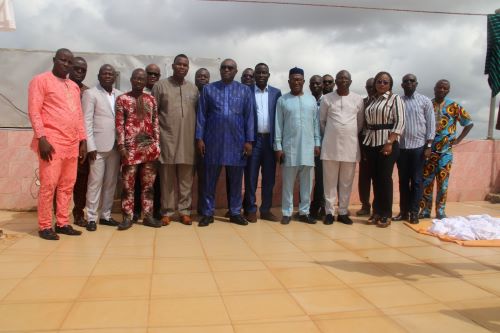
In June 2022, the LoCAL-Benin team organized a three-day training of trainers’ session in the south-central town of Bohicon, some 125 km north of the capital Cotonou. Attended by 12 trainers associated with the local administration training center (CeFAL), the aim of the workshop was to create a body of trainers who can provide instruction and support in LoCAL implementation to local government authorities.
CeFAL participants learned how to support local government authorities in understanding climate change adaptation and its mainstreaming into local planning processes, the fundamentals of the LoCAL mechanism, and its tools to realize adaptation actions at the local government level.
The training was built on previous cooperation between the Local Climate- Adaptive Living Facility and the Center for Adaptive Living, which involved the development of a training module to better understand climate change risks and impacts to inform development plans at the local government level.
Improved planning across West Africa made easier with LISA
Another activity being funded through ACCF is the development of the Local climate Information System for Adaptation, known as LISA, for implementation in Benin to target local government authorities. Expected to be finalized in the latter half of 2022, LISA aims to provide local government authorities and adaptation responders with the localized climate data they need to make climate resilience planning and development investments. Read more